

First and foremost, this was a wildly engaging read (or listen, for the Audible fans. The voice actor knocked it out of the park).
One of my favorite things about non-fiction is the fatalistic way things seem to fall into place, like threads stitching in real time to create the outcome we expect. Decades of Beatrice Sparks building her dream life from the ground up and languishing in author limbo (relatable) all feel like they’re building to her big break…
And then, her name becomes “Anonymous.”
In Unmask Alice: LSD, Satanic Panic, and the Imposter Behind the World’s Most Notorious Diaries, Emerson does a great job providing the historical context for the maelstrom of unfortunate events that developed Go Ask Alice.
As someone a little too young to remember Go Ask Alice or the Satanic Panic happening in real time, I read/listened with morbid fascination at the way real life tragedies were twisted, manipulated, and then conveyed in a way that changed American culture. Are there sources sited? No. Does that negatively impact my reading? Also, no.
Go Ask Alice

It started when she was served a soft drink laced with LSD in a dangerous party game. Within months, she was hooked, trapped in a downward spiral that took her from her comfortable home and loving family to the mean streets of an unforgiving city. It was a journey that would rob her of her innocence, her youth — and ultimately her life.
Read her diary.
Enter her world.
You will never forget her.
For those unfamiliar, Go Ask Alice was a diary-style novel published in 1971 that sent parents and teens into a frenzy. Championed by Art Linklater in the wake of his daughter’s suicide, this book helped shape opinions of the broader culture in a way that helped fuel Nixon’s War on Drugs and is still immensely popular. While it scared many a teenager straight over the years, it also purported to be… a real diary.
Now, my qualms with this aren’t too terrible. An author, desperate to make her break, is willing to compromise on a by-line that will end up hindering book sales in order to reach readers. Fair.
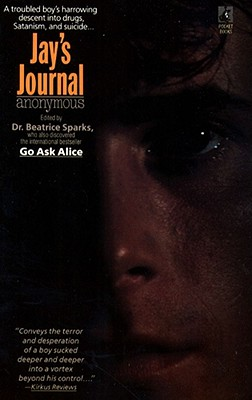
The issue comes with Beatrice Sparks’ follow up, Jay’s Journal.
Based (very loosely) on a real-life journal of a real-life boy who chose to end his real life, and in doing so deeply impacted the real lives of everyone who knew and loved him, Jay’s Journal is framed by Emerson as a cash-grab for Sparks.
Unable to recreate the magic of her first book, Sparks borrowed a few select journal entries from Alden Barrett’s notes and filled in the rest with blood-fueled orgies, devil worship, and a plot straight from a horror movie.
And the public took notice.
Needless to say, his family and community were devastated, in every sense.
Ultimately, this journey through history was highly interesting to me. Emerson gives a long-overdue sense of life to the deceased whose inner world(s) were mined for content. That Dr. Beatrice Sparks, PhD* isn’t here to refute it feels a little like just desserts.
*No doctorate found
 Illegibly K.M. West
One response to “Unmask Alice”
I remember Go Ask Alice. I’m old but this looks really good. Thanks. Sent from my iPhone